
Remote Area Solar Power: What Works, What Fails, & How to Size Your System in Australia
Moving to a rural property often teaches you a quick lesson about power. It can be unreliable, expensive, or both. In many parts of regional NSW, power outages are common. Many homes still rely on a generator more than they'd like.
A standard metro solar setup might include 6.6 kW of panels with a 5 kW inverter. This works well for reducing electricity bills.
However, remote area solar power is a different challenge. You are effectively building a mini power station for your home, shed, or business. This system must keep running through cloudy winter stretches and handle sudden power demands from pumps or tools.
This guide will help you build a reliable power system. You will learn:
- Which setup best suits your property: grid-connected, hybrid, or off-grid.
- How to correctly size your solar panels (kW), off grid solar battery (kWh), and backup generator.
- What commonly causes problems in remote solar systems and how to avoid them.
- How to compare quotes clearly, focusing on what matters.
If you're still weighing up system types, start with our detailed comparison: Off-Grid Solar Systems vs Hybrid Solar: Which Is Right for You?.
What Makes Remote Solar Systems Reliable (and What Doesn't)

Remote systems work best when designed for your toughest weeks, not just the sunniest days.
What Usually Works
A good design clearly outlines the essentials:
- Winter-focused sizing: This means looking beyond average daily output.
- A clear plan for essential loads (what must stay on) and peak loads (pumps, tools, air conditioning).
- Generator integration: How it will work if you need one.
- Australian warranty support: Components should have local backing and a clear service process.
What Often Falls Short
These are common reasons why remote systems don't meet expectations:
- Undersized batteries: Systems sold as 'whole-house backup for days' often fall short.
- Designs based on averages: These often fail to account for seasonal changes.
- Undersized solar inverters: They struggle to handle pump starts, welders, or air conditioners.
Key Factors Driving Cost
Remote and off-grid solar energy solutions vary significantly in price. The main cost drivers are typically:
- Battery capacity (kWh): How much energy you can store.
- Backup systems: This includes the generator and how it connects.
- Site complexity: Factors like distance from the grid, three-phase power needs, mounting options, and shade.
Step 1: Choosing the Right Solar Setup for Your Rural Property

Many rural properties aren't truly off-grid. You might have grid power, but the line could be long, leading to frequent outages. Export limits can also reduce the financial value of standard rooftop solar.
The Three Main Choices
1) Grid-Connected Solar (No Battery)
This option has the lowest upfront cost. It suits properties with a stable grid connection where the primary goal is to reduce electricity bills.
2) Hybrid Solar (Solar Panels, Battery, and Grid Connection)
This is a popular choice for bill control and backup during outages. The grid remains a reliable safety net. Many comparing solar Byron Bay and solar Ballina providers choose hybrid for improved resilience without the full commitment of going off-grid.
For a clear explanation, read: Hybrid Solar Systems Explained (How They Keep You Powered 24/7).
3) Off-Grid Solar (Solar Panels, Battery, and Generator)
With an off-grid system, you generate and store all your own power. Your system must be strong enough to cover your energy needs during the worst winter weather, not just sunny summer periods.
Common Pitfalls in Remote Area Solar Power (and How to Avoid Them)
Failure 1: Designing for Sunny Days, Not Winter
A common issue is a system that works brilliantly in summer but relies heavily on a generator in July. A winter-ready design considers:
- Shorter days with less sunlight.
- More cloud cover and rain.
- Seasonal demand changes, like increased heating or longer lighting hours.
Always ask for this check: A good design shows estimated performance across a sunny summer week, a cloudy winter week, and a shoulder-season week (autumn or spring).
Failure 2: Ignoring Peak Loads and Motor Start Surges
Your daily energy use in kWh is important. However, your peak power (kW) demand is what can trip systems. Common rural culprits for high peak loads include:
- Bore and pressure pumps.
- Workshop tools and welders.
- Pool pumps.
- Air conditioners.
- Electric hot water systems.
Motor starts can draw two to six times their running power for a short time. This is why selecting the right solar inverters for your needs is critical.
Failure 3: Treating the Generator as an Afterthought
If you need a generator, it should be part of the initial design. It's not an optional extra. Poor integration often leads to:
- Annoying system trips.
- Slow battery charging during bad weather.
- Awkward manual changeovers.
- A system that only works if someone is home to manage it.
If your goal is to reduce generator run hours, this guide is essential reading: How Solar Batteries Cut Generator Use & Fuel Costs by 95%.
Failure 4: Relying on a Big Battery Without a Load Plan
An off grid solar battery won't fix wasteful energy use. If you want reliable blackout protection, you need a plan for what appliances will stay on.
Good remote designs often include:
- An essential loads circuit for vital items like fridges, lights, communications, and selected power points.
- Simple rules for heavy loads during periods of low solar production (e.g., pumps, hot water, air conditioning).
- A clear strategy for 'generator days' if you're off-grid.
How to Size Solar Panels (kW) for a Remote Property
Solar sizing serves two main purposes:
- To directly power your daytime loads.
- To fully recharge your battery after overnight use.
Begin by estimating your average daily energy use:
- 10–20 kWh/day: Typical for a smaller rural home with efficient appliances.
- 20–35 kWh/day: Common for a family home with pumps or more refrigeration.
- 35–60 kWh/day: For larger homes, workshops, or small business loads.
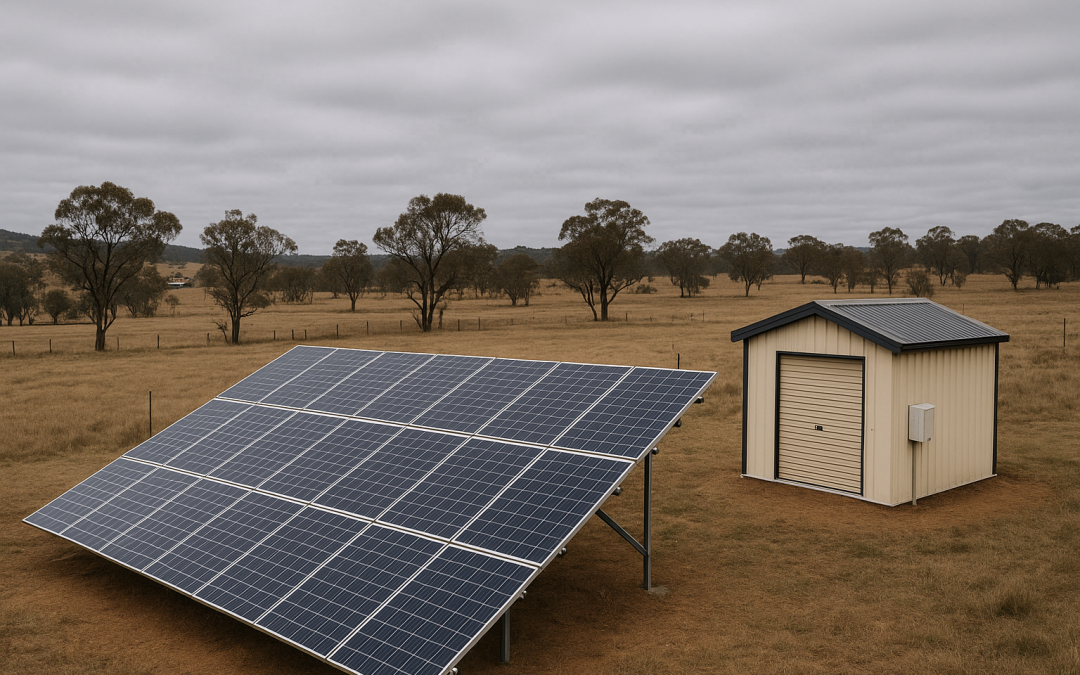
Next, assess your roof space and any shading. For rural blocks, ground-mount solar panels can be an excellent option. This often provides better access, optimal orientation, and easier future expansion.
Orientation and Shade: Small Details, Big Impact
North-facing panels remain the most efficient. However, east/west orientations can suit homes with energy use spread throughout the day.
Shade is a major problem, especially:
- Moving tree shade that shifts across panels.
- Winter shade that might not have been obvious in summer.
If shade is present, your quote should clearly explain the design approach. This includes the string layout and the chosen solar inverters.
Oversizing Panels vs. Inverter Rating
Your solar panels (kW) and inverter (kW) don't have to match exactly. It's common practice to oversize the panels to boost winter output. What matters most is whether the inverter can handle:
- Peak loads and sudden surges.
- The battery charging needs (for hybrid or off-grid systems).
- High temperatures and long operating hours, typical in Australian conditions.
How to Size a Battery (kWh) Without Guessing
Battery sizing comes down to one question: what must run after sunset? Create a 'night list' to keep your budget realistic. Typical night-time loads often include:
- Fridges and freezers.
- Lights.
- Wi-Fi and device charging.
- Television.
- Small kitchen appliances.
- Essential medical equipment (if applicable).
Step 1: Estimate Your Overnight Energy Use
If you don't have existing energy monitoring, these ranges offer a good starting point:
- Smaller homes: 6–10 kWh overnight.
- Family homes: 10–18 kWh overnight.
- Larger homes: 18–30 kWh overnight.
Remember to factor in energy conversion and round-trip losses from the battery and inverter. Also, include reserve capacity for battery health and unexpected backup events. A '10 kWh battery' doesn't always mean '10 kWh usable every night'.
Step 2: Define Your Backup Goal (This Changes the Size)
Identify the primary purpose of your battery:
- Bill shifting: Storing solar power for evening use.
- Short outages: Keeping essential services running overnight.
- Long outages: Relying on generator charging combined with careful load management.
Extended outage coverage with minimal generator use requires more solar panels and batteries. This is a key budget decision.
If you're deciding where to invest first between solar panels and batteries, read: Solar Batteries vs Solar Panels Which One Should You Choose.
Step 3: Match Battery Capacity to Inverter Power (kW)
A large battery paired with a small inverter can still limit your appliance usage. The inverter determines how many appliances can run simultaneously.
As a quick guide:
- Hybrid solar often backs up specific essential circuits.
- Off-grid solar typically needs higher inverter capacity because there's no grid to support heavy loads.
Solar Inverters for Remote Installs: What Matters Most

Your solar inverter acts as the system's traffic controller. It manages what runs, what charges, and how your system behaves during a power outage. For remote area solar power, prioritise these features:
- A clear Australian warranty process.
- Strong performance in high temperatures, with proper mounting and ventilation.
- User-friendly monitoring that provides useful data.
- Compatibility with your chosen battery and generator (if applicable).
If you're comparing popular models, including Fronius solar inverters or Sungrow solar inverters, this guide offers expert advice: Best Solar Inverters Australia (2026 Expert Guide).
Single-Phase vs. Three-Phase on Rural Properties
Many rural homes operate on single-phase power. However, sheds or small businesses may require three-phase. If you have three-phase loads (e.g., large pumps, machinery), your design should clearly state:
- Which loads will be backed up.
- Whether backup is per-phase or across all phases.
- How generator input will be managed if used.
The 'Best Solar Inverters' Are Right for Your Site
Many people ask for the best solar inverters. A more practical question is: which inverter is most suitable for your specific loads and can be easily serviced where you live? Ask your installer:
- What happens if the inverter fails in year eight?
- Who handles the warranty process locally?
- How long might you be without support?
- Who covers labour and call-out costs?
Generator Integration: Don't Overlook This Crucial Component
If you're off-grid, a generator is almost always essential for most homes. Even for remote grid-connected properties, a generator can make sense where outages are frequent or prolonged.
A well-designed system answers these questions in writing:
- Will it be manual start or auto-start?
- Does it charge the battery through the inverter/charger?
- Which loads can run while the battery is charging?
- What's your fuel plan for extended periods of bad weather?
A Simple Rule for 'Generator Days'
There will be times when your solar won't cover all your needs. During those periods:
- Run heavy loads while the generator is on (e.g., pumping, hot water, workshop tasks).
- Use your battery for quiet, night-time power.
- Don't expect the battery alone to replace the generator during multi-day cloudy spells.
This approach is normal. The goal is to significantly reduce generator hours, not necessarily to eliminate them entirely.
Solar Panel Maintenance for Rural and Coastal Properties

Remote properties face unique challenges like dust, leaf litter, bird droppings, and coastal salt exposure. Maintenance isn't complicated, but skipping it can significantly reduce your solar output when you need it most.
A simple maintenance schedule includes:
- Every 3–6 months: A visual check for debris, overhanging branches, or new shading.
- Every 6–12 months: Washing panels if dirt build-up is noticeable (more often on farms or near the coast).
- After storms: Inspect for damage, slipped tiles, and any roof penetration issues.
- Yearly: Review your monitoring data for any output drops or recurring inverter errors.
For a detailed checklist, see: 7 Maintenance Tips for Solar Panels to Lower Energy Bills.
How to Compare Remote Area Solar Power Quotes
A good quote should be a clear plan, not just a list of parts.
1) Are kW, kWh, and Backup Limits Clearly Stated?
Look for:
- Solar array size (kW) and assumptions for winter performance.
- Battery's usable capacity (kWh) and a list of circuits it will back up.
- Inverter rating (kW) and how it handles start surges.
- Details on generator integration if your system is off-grid.
2) Does the Quote Include a Load Assessment?
If you have pumps, a workshop, or business equipment, the quote should address:
- Your property's peak loads.
- Motor start/surge needs.
- Options for load control, such as timers, soft starters, or staged starting.
This is important whether you're installing solar panels and batteries together or planning a staged approach.
3) Are Components Chosen for Australian Support, Not Just Price?
Some brands are popular for their availability and value. Others are chosen for their monitoring features, warranty structure, or battery compatibility.
Key checks that matter:
- Warranty terms that you can genuinely rely on.
- A clear local support pathway.
- The installer's experience with that specific system configuration.
4) Does the Quote Explain What Happens in a Power Outage?
You want a straightforward explanation in plain English:
- What appliances will remain on?
- What will turn off?
- What cannot run simultaneously?
- How long the backup power is likely to last on typical night loads?
5) Is the Installer Accredited and Compliant?
Confirm:
- CEC-accredited designer and installer.
- Clear single-line diagrams and full compliance paperwork.
- Correct labelling and isolation points.
Find more helpful explanations on our blog: Solar & Battery Advice for Australian Homes | Freedom Energy Blog.
Rebates, Feed-in Tariffs, and Payback (Realistic Expectations)
If your remote property is grid-connected, your system's payback period heavily depends on how much solar power you use on-site. The feed-in tariff (FiT) is what you get paid for excess solar energy exported to the grid. These rates vary by retailer and can change over time.
In most cases, FiTs are modest. This means that using your own solar power (self-consumption) is usually more valuable than exporting it.
For current rebates, check the rules for your postcode. Rates and eligibility often change: Slash Your Bills – Australian Federal Government Solar Rebate….
Local Notes: Solar in Byron Bay, Ballina, and Tamworth
While we see consistent patterns across NSW, design specifics adapt to local conditions.
- Solar panels Ballina and solar panels Byron Bay installations often require extra consideration for coastal exposure, humidity, and storm season.
- Hinterland properties can face significant shade from tall trees and may need longer cable runs.
- Inland and tablelands projects, including those researching off grid solar Tamworth, typically have different winter heating loads and longer cold spells.
If you're choosing between installers for solar Byron Bay or solar Ballina, the same rules apply. Your quote should clearly explain assumptions for winter performance, peak loads, and backup limits.
Quick Rules for a System That Performs Through Winter
Use these points before you commit to a system:
- Grid-connected, but outages are the main problem: A hybrid solar system with essential-load backup is often the cleanest solution.
- Off-grid, or the grid is too unreliable: Size the off grid solar battery for your night-time use, then size the solar array to refill it, even in winter.
- Heavy loads like pumps, tools, or business equipment: Size the solar inverters for surge capacity, not just average power.
- Want fewer generator hours: Ensure generator charging is properly integrated and plan 'generator windows' for heavy loads.
- If two quotes look similar: Choose the one that clearly explains its winter assumptions and backup limits.
Need a Sanity Check on Your System Sizing?
If you're comparing remote solar quotes or planning solar panels and batteries from scratch, we can help you review the numbers. Send us:
- A recent power bill or your current generator run hours.
- Your postcode.
- A list of your biggest loads (e.g., pumps, hot water type, air conditioning, workshop gear).
We'll help you sanity-check your solar array, off grid solar battery storage, solar inverters, and overall backup approach to ensure you get the right solar energy solutions for your property.
If you're leaning towards a hybrid system, read this next: Hybrid Solar Systems Explained (How They Keep You Powered 24/7).
{“@context”:”https://schema.org”,”@graph”:[{“@context”:”https://schema.org”,”@type”:”BlogPosting”,”headline”:”Remote Area Solar Power: What Works, What Fails, & How to Size Your System in Australia”,”description”:”Remote properties need reliable solar. Learn what works, what fails, and how to size your system for Australian conditions. Get expert advice for your rural home.”,”datePublished”:”2026-06-04T00:08:40.282Z”,”dateModified”:”2026-06-04T00:08:40.282Z”,”mainEntityOfPage”:{“@type”:”WebPage”,”@id”:”https://freedomenergysolutions.com.au/remote-area-solar-power-in-australia-what-works-what-fails-and-how-to-size-solar-battery-backup/”},”url”:”https://freedomenergysolutions.com.au/remote-area-solar-power-in-australia-what-works-what-fails-and-how-to-size-solar-battery-backup/”,”author”:{“@type”:”Person”,”name”:”FREEDOM ENERGY SOLUTIONS”},”image”:[“https://freedomenergysolutions.com.au/wp-content/uploads/2026/06/featured-1-9.png”],”publisher”:{“@type”:”Organization”,”name”:”FREEDOM ENERGY SOLUTIONS”,”logo”:{“@type”:”ImageObject”,”url”:”https://freedomenergysolutions.com.au/wp-content/uploads/2017/07/freedom-energy-large.png.webp”}}},{“@context”:”https://schema.org”,”@type”:”FAQPage”,”mainEntity”:[{“@type”:”Question”,”name”:”What’s the best solar setup for a remote property?”,”acceptedAnswer”:{“@type”:”Answer”,”text”:”The best setup depends on your property. Choices include grid-connected (bill reduction), hybrid solar (bill reduction and blackout backup), or off-grid solar (complete independence with generator backup). We help you choose based on your needs.”}},{“@type”:”Question”,”name”:”How do I size my solar panels and battery for a remote home?”,”acceptedAnswer”:{“@type”:”Answer”,”text”:”Start by calculating your average daily energy use (kWh) and peak power demand (kW). Size your solar panels to cover daytime use and fully recharge your battery, even in winter. Size your off-grid solar battery for your essential night-time loads, plus a reserve for cloudy days.”}},{“@type”:”Question”,”name”:”What common mistakes should I avoid with remote solar power?”,”acceptedAnswer”:{“@type”:”Answer”,”text”:”Avoid systems designed only for sunny days. Ensure your solar inverters can handle peak loads and motor surges from pumps or tools. Don’t treat the generator as an afterthought; integrate it properly. Always have a plan for essential loads, even with a large battery.”}},{“@type”:”Question”,”name”:”Are solar rebates available for remote area solar power systems?”,”acceptedAnswer”:{“@type”:”Answer”,”text”:”Yes, depending on your property’s connection type and your postcode, you may be eligible for Australian federal government solar rebates. Feed-in tariffs also apply if you’re grid-connected. These rates and rules can change, so it’s best to check current guidelines.”}},{“@type”:”Question”,”name”:”Why is local support important for solar inverters and batteries?”,”acceptedAnswer”:{“@type”:”Answer”,”text”:”Local Australian warranty support for solar inverters and off-grid solar batteries is crucial. It ensures quicker service, clearer communication, and peace of mind if a component needs repair or replacement, especially in remote areas.”}}]}]}
Recent Comments