
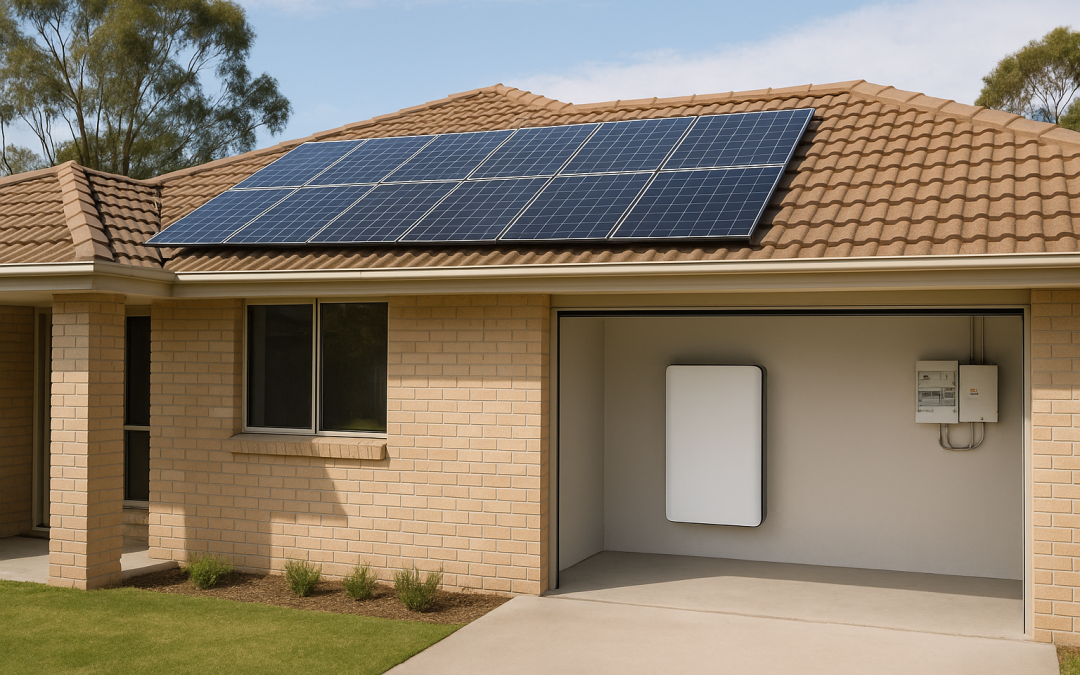
Off-grid battery power: how to run your home reliably (without overbuilding it)
Off-grid power can be reliable in Australia. To achieve this, design your system for winter, multi-day cloud, and the typical loads found on rural properties. This guide focuses on choices that improve day-to-day reliability, helping you avoid overspending or relying too much on a generator.
You’re usually looking at off-grid for these reasons:
- Grid connection costs are high (especially with long runs)
- Outages are common where you live
- You’re tired of refuelling a generator whenever the weather turns
On paper, off-grid is simple: solar makes energy, the battery stores it, and your home uses it later. The real challenge is making it predictable all year round.
This means planning for winter yield drops, multi-day cloud, and loads people often miss. These include pumps, long cable runs, sheds, electric fences, septic aeration, and always-on electronics. It also means installing equipment where heat, salt air, and poor ventilation won’t cause derating or warranty issues, especially in coastal QLD and NSW.
What “off-grid battery power” really means
An off-grid solar battery system supplies your home without relying on the electricity network.
This changes your priorities. A grid-connected battery often focuses on bill savings and backup for a few circuits. Off-grid is about reliability first, because you can’t buy missing energy from the grid during a gloomy winter week.
Typical parts of an off-grid system
- Solar panels (kW): Your main energy source.
- Battery storage (kWh): Supplies power overnight and buffers for low-sun periods.
- Inverter/charger (kW): Converts battery DC into household AC and manages charging.
- Backup generator (often): Covers extended low-solar periods and unusual loads.
- Switchboard + protections: Includes isolation, fusing, surge protection, earthing, and compliant wiring.
Not fully off-grid? Consider hybrid
If you want more self-sufficiency and blackout resilience (but still have grid access), a hybrid power system can be a better fit. You stay connected to the grid, store solar in a battery, and keep essential circuits running during an outage.
Internal read: Hybrid solar solutions guide
Step 1: List your “must-run” loads (especially on rural blocks)
Before you choose a battery brand, get clear on what you actually need to power every day. Start by splitting your home into two lists.
Must-run (every day)
- Fridges/freezers
- Water pump or pressure pump (tank water)
- Lights
- Internet + phone charging
- Medical equipment (if relevant)
- Septic aeration (common on rural properties)
- Bore pump control gear (even if the pump is scheduled)
If you’re not sure what’s “must-run”, imagine you’ve had two cloudy days and are trying to avoid starting the generator. What still needs to work?
Nice-to-have (when solar is strong)
- Air con / electric heating
- Pool pumps
- Workshop tools (welders, compressors, dust extraction)
- EV charging
- Hot water boosting (electric storage)
Easy-to-miss constant loads
- Starlink/NBN + Wi-Fi
- CCTV
- Gate motors
- Electric fences and energisers
- Sump pumps
This step keeps your system realistic. It also helps you avoid a common mistake: designing around rare peak loads, then paying for a battery bank you barely use.
Rural wiring: Why long cable runs matter
On rural sites, long feeder runs to sheds, pump houses, gates, troughs, or second dwellings are common. Voltage drop and cable sizing matter more than most people expect, especially with motors.
It’s not only “can the inverter run it?”. It’s also:
- “Will the pump start cleanly at the end of a long run?”
- “Will the voltage sag and cause nuisance trips?”
- “Do we need soft-start, VSDs, or a dedicated supply for a motor?”
On properties around places like Byron, Tweed Heads, Tamworth, and Armidale, a mix of house loads and infrastructure loads is common. Getting the electrical design right early prevents a lot of frustration later.
Step 2: Understand kW vs kWh (this drives daily comfort)
Two numbers decide how an off-grid system feels: kW (kilowatts) for how much power you can run at once, and kWh (kilowatt-hours) for how much energy you can use over time.
Example:
- A kettle might draw about 2 kW while it’s on.
- If it runs for 6 minutes, that’s about 0.2 kWh.
Quick diagnosis
- “The system trips when the pump starts” usually points to kW and surge issues.
- “We’re on the generator by 9 pm” usually points to kWh and winter planning issues.
Motor starting currents can be several times the running load. That’s why a system can look fine on paper, yet struggle when a bore pump or compressor kicks in.
Step 3: Size the battery for overnight use (then plan for winter and multi-day cloud)

To size your off-grid battery, ask two key questions: How many kWh do you use from sunset to sunrise? And, how many low-solar days do you want to cover without a generator? Many systems are undersized because they don’t plan for winter.
Winter realities in Australia
Winter is where off-grid systems are truly tested.
- Shorter days mean less solar production.
- Lower sun angle and more overcast days reduce battery charging.
- In parts of NSW and SEQ, multi-day cloudy stretches do happen.
- Heating loads can rise quickly.
If your system is sized for summer only, it can feel effortless for half the year and tight for the other half. That’s when people start chasing the state of charge and burning more fuel than expected.
A practical way to think about it
- Battery: Covers overnight use and short dips in solar.
- Solar: Handles daily battery refills.
- Generator (or other backup): Provides insurance for poor weather and unusual loads.
Want a deeper sizing breakdown? Read: Remote area solar power: what works, what fails, and how to size battery backup
Step 4: Choose the right battery (and respect heat, ventilation, and warranty)
Most modern home systems use lithium storage. In off-grid setups, product choice and warranty support are vital. However, the installation environment is just as crucial.
A battery in a hot, poorly ventilated space may limit its output (derating) or protect itself by shutting down. This is often a predictable response to heat, not a “fault”.
What to check before choosing
- Cycle life and warranty terms: What’s covered, and under what conditions.
- Operating temperature range: Critical for hot garages, sheds, and plant rooms.
- Power output (kW): Can it run pumps and kitchen loads without drama?
- Monitoring and fault reporting: Speeds up troubleshooting.
- Local support: Australian warranty support matters.
Coastal heat and humidity: a real constraint
In coastal QLD/NSW (Brisbane/SEQ through Byron and Tweed), heat and humidity affect where batteries and inverters should go.
Rules of thumb:
- Avoid unventilated tin sheds that bake in summer.
- Don’t assume “the garage is fine” if it’s sealed and gets afternoon sun.
- Keep clearances and airflow as specified—many warranties depend on temperature, clearance, and ventilation.
- Consider salt air and corrosion risk if you’re close to the coast.
This isn’t fussiness. Heat can reduce available power, shorten service life, and trigger shutdowns on hot afternoons—often when you’re also running cooling loads.
If you’re comparing a sonnen battery (often searched as “sonnen solar battery”) against other options, compare based on your loads, backup expectations, and where the battery will physically live.
Internal read: sonnen Battery Australia guide
Step 5: Get the inverter, changeover, and surge protection right
Batteries get the attention, but the inverter is the traffic controller. It must handle surges, manage charging, and coordinate backup sources reliably.
For off-grid battery power, the inverter/charger should:
- Supply stable AC power.
- Charge the battery correctly.
- Accept solar input (directly or via charge controllers).
- Start and manage generator charging when required.
Plain-English versions of common terms
- Switching: Automatic changeover between solar/battery and generator (and grid, if hybrid).
- Console management: The monitoring portal and settings (charge limits, generator triggers, alarms).
Good settings make the system feel calm and predictable. Bad settings create nuisance generator run time, shallow battery cycling, and confusing low-battery events.
Blackout resilience (even for near-off-grid hybrid homes)
Outages are part of life in many parts of NSW and SEQ, especially during storm season. Even if you’re not fully off-grid, it’s worth planning how the system behaves when the grid is unstable.
A robust design usually includes:
- Essential circuits on backup (not everything).
- Surge protection and proper earthing (important for rural runs and exposed sites).
- Generator integration if you need multi-day autonomy.
For most homes, blackout essentials are: fridge/freezer, lights, comms, and water pressure. If you want to run heavy loads in an outage (like large air con, ovens, or workshop gear), plan for it explicitly. Otherwise, you can end up with a “backup system” that works, but not how you expected.
Step 6: Plan your solar array for winter (not just roof space)
Off-grid solar isn’t about fitting “whatever fits on the roof.” You need reliable winter charging, even after a couple of grey days.
Practical design checks
- Panel orientation and tilt: Winter sun angle matters.
- Shading: Small shadows can dent output, especially in low sun.
- Ground-mount vs roof-mount: Ground-mount is often easier to aim and maintain on rural blocks.
- Panel quality: Off-grid sites benefit from strong warranty backing.
If you’re choosing panels as part of a full build, this guide helps: REC TwinPeak 5 Black guide
Step 7: Generator support isn’t a failure. It’s good planning.
A “no generator ever” design is possible, but it often costs more than needed. It can also feel stressful during extended cloud, as you’re forced to ration loads.
A generator can be the cheapest way to cover:
- Several days of rain.
- Unexpected guest loads.
- Poor solar periods in winter.
- High-demand tasks (e.g., big workshop jobs, heavy pumping).
The best off-grid setups use a generator rarely, but confidently. It should start when needed, charge efficiently, then shut down.
Generator integration isn’t just “plug it in”. Correct changeover, earthing, and settings help avoid inefficient idling, short cycling, and nuisance alarms.
Remote blocks: when ‘pole and wire’ costs make RAPS worth comparing
Sometimes the trigger is simple: getting grid power to the site is expensive. If you’ve been quoted for long runs of poles, trenching, and network upgrades, compare that spend against a properly designed RAPS (Remote Area Power Supply).
It’s not automatically cheaper to go off-grid. The honest approach is a site-specific comparison based on your loads, autonomy expectations, generator appetite, and the real connection scope.
A common middle ground is “near-off-grid”: a hybrid setup that covers most needs, with the grid (or generator) acting as an occasional top-up. That can reduce fuel use and keep you comfortable through storm season outages.
Common off-grid battery mistakes (and how to avoid them)

1) Sizing the battery without a load audit
If you don’t know your overnight kWh, you’re guessing. Even a short audit beats a guess.
If you don’t have monitoring yet:
- Note what runs after dark.
- Check any nameplates for pumps.
- Identify anything that cycles overnight (fridges, aerators, comms).
2) Forgetting surge loads
Pumps, compressors, and workshop tools can need high starting power. You might have enough kWh, but the inverter kW limit trips.
3) Designing for summer performance
Your system must survive winter. Summer is the easy season.
4) Assuming the battery can live “anywhere out of the way”
Heat, humidity, and ventilation affect performance and warranty conditions.
5) No clear essential-circuits plan
Some loads should never be able to flatten your battery overnight. Hot water boost, underfloor heating, and workshop circuits are common culprits.
On rural properties, also consider what happens if someone starts a big load at the wrong time (for example, an irrigation or bore pump scheduled late in the day).
What about batteries for businesses?
Off-grid businesses exist too: farms, tourism sites, workshops, and comms sites. Even for grid-connected sites, businesses often look at storage after seeing solar savings.
Where business solar value usually starts
- Lower daytime energy costs.
- More control over operating costs.
When batteries can stack up
- High evening loads.
- Backup needs for refrigeration, IT, or pumps.
- Generator use during peak periods.
If you share your tariff, operating hours, and top loads, it’s usually possible to tell early whether storage is worth pricing. Sometimes the first win is better load shifting, solar sizing, or site electrical work.
Location notes: Byron Bay, Tweed Heads, Brisbane/SEQ, Tamworth, Armidale and beyond
We see searches like solar battery Byron, battery install Brisbane, and solar power Tamworth because conditions and usage patterns vary across regions.
- Coastal sites (Byron, Tweed, Brisbane/SEQ): Allow for salt air, humidity, and hot afternoons. Careful battery/inverter placement and ventilation can prevent avoidable derating.
- Inland and tablelands (Tamworth, Armidale): Winter performance and heating loads matter. Clear skies can help, but cold nights can increase overnight use.
- Rural properties everywhere: Pumps, sheds, and long feeders are common. Good design requires as much electrical engineering as it does solar expertise.
If you’re outside the Northern Rivers, still reach out. We’ll tell you what we can handle directly and what’s best delivered with a trusted partner team.
Related local read: Solar Tweed Heads guide
Battery install Brisbane (and SEQ): what to expect from a compliant installer
If you’re searching battery install Brisbane, choose an installer who’s upfront about compliance, limitations, and heat management—not just battery capacity.
A good installer should be able to explain:
- Battery and inverter compatibility (including backup functions, export limits where relevant, and what happens during an outage).
- Battery location to meet clearances, ventilation, and manufacturer requirements (and avoid heat soak).
- How essential circuits are selected and labelled (so you know exactly what stays on).
- Protection and isolation, including correct switchboard work and signage.
- Commissioning and handover: App setup, settings, and what alarms mean.
Also ask how the system behaves in the conditions SEQ actually gets: hot afternoons, high humidity, summer storms, and the occasional multi-day cloudy run.
Quote-ready checklist (bring this to your installer)
- Address and whether you have grid access.
- Must-run circuits (and any big loads).
- Recent power bills (if grid-connected).
- Generator details (if you have one).
- Roof type, roof space, and any known shading.
- Single-phase or three-phase supply (if grid-connected).
- Your goal: lowest generator run time, best reliability, or lowest up-front cost.
- Rural specifics: bore/tank pump, septic aeration, electric fences, shed/workshop plans, long feeder runs.
Ready to plan your off-grid battery power system?

If you want a system that feels reliable in winter (not just impressive in summer), we can help.
Send Freedom Energy Solutions your address and a quick list of must-run circuits. We’ll come back with a practical recommendation for solar size (kW), battery storage (kWh), and inverter capacity (kW), plus a sensible generator plan for your site.
CTA: How to choose the right solar battery for your off-grid home (then request a quote from the page)
More straight answers here: Freedom Energy Solutions blog

FAQs
What’s the best battery for an off-grid solar system?
The best battery matches your overnight kWh, your required kW (surge and continuous), and your site conditions (especially heat and ventilation). It should also be backed by strong Australian warranty support.
Brand matters, but correct sizing, a smart generator strategy, and compliant installation matter more.
How long will an off-grid battery run a house?
It depends on your loads, usable battery capacity (kWh), and how much solar you get the next day.
For example, if your home uses 10 kWh overnight and your usable battery capacity is 20 kWh, you have headroom for two lighter nights, or one heavy night plus a buffer. Heating, cooling, pumps, and cooking can change this quickly.
Multi-day cloud is usually solved by a mix of battery capacity and a planned backup source, rather than trying to buy enough batteries to cover every worst-case week.
Do I need different batteries for solar systems than for backup power?
Many home batteries can handle both stored solar and backup. However, not every product supports full off-grid operation.
Backup (hybrid) and off-grid designs have different requirements for inverter behaviour, changeover, protections, and charging sources (including generator integration).
Can you install batteries in Brisbane?
If you’re looking for battery install Brisbane, we can assess your site and confirm the best delivery option.
The key is matching battery and inverter compatibility, meeting manufacturer installation conditions (clearances, ventilation, and temperature), using compliant protections, and wiring essential circuits so backup behaves as you expect.
Is it cheaper to go off-grid than pay for grid connection?
Sometimes—particularly when the grid connection scope is large or the run is long.
Off-grid systems usually cost more upfront than a standard grid-tied solar system. However, you may avoid significant pole-and-wire costs and some ongoing charges. A site-specific comparison is the only honest way to decide.
Can I start hybrid and move to off-grid later?
Sometimes, yes. It depends on the inverter, battery compatibility, changeover setup, and whether the system can accept the extra solar and storage you’ll need.
If “off-grid later” is part of your plan, say so early. This ensures the initial design doesn’t limit your future options.
Recent Comments