
How to size an off grid solar and battery system
Every reliable off grid system comes down to four numbers: your daily load, your autonomy target, an array that can refill the batteries in winter, and a generator plan for the week the weather refuses to cooperate. This guide walks through each one with a worked example, the same way we size systems for real properties from the Byron hinterland to the New England tablelands. Questions on the way through? Call 0420 141 078 and ask, it is what we are here for.
Estimate your daily load, honestly
Off grid design starts with kilowatt hours per day, not panels. If you live in the house now, your retailer portal has the real number. For a new build, you make a load list. Here is a realistic one for a full time rural home with a wood fire for heating, gas or solar hot water, and a decent workshop in the shed. The figures are illustrative appliance estimates to show the method, and your design uses your actual appliances.
| Load | Pattern | Daily energy |
|---|---|---|
| Fridge and chest freezer | Run around the clock, compressors cycling | 2.0 kWh |
| Bore and pressure pumps | House water and stock trough, about an hour of combined run time | 1.1 kWh |
| Kitchen cooking | Induction cooktop, kettle, toaster, mostly evening | 2.0 kWh |
| Lighting | LED throughout, evening hours | 0.8 kWh |
| Workshop tools | Saw, drill press, compressor, intermittent daytime use | 1.5 kWh |
| TV, laptops and charging | Evenings, plus devices topped up through the day | 0.8 kWh |
| Internet, comms and monitoring | Always on, satellite broadband router included | 0.5 kWh |
| Washing machine | Cold cycles, run in daylight hours | 0.4 kWh |
| Fans and small appliances | Ceiling fans in summer, electric blanket in winter | 0.9 kWh |
| Total | A comfortable full time household | 10.0 kWh |
Two things to notice. First, the pumps and the workshop are on the list; on rural properties the loads that “only run sometimes” are the ones that catch people out, both in daily energy and in the start up surge that sets the inverter size. Second, look at what is not on the list: electric hot water, ducted air conditioning and EV charging each add many kilowatt hours a day and change the whole design. You can absolutely have them off grid, but they must be designed in from the start, usually as daytime loads that run when the sun is doing the work.
Autonomy days: how long the batteries carry you
Autonomy is the number of days the battery bank can run the property with little or no solar input. It is the single biggest lever on system cost, so it deserves a deliberate decision rather than a default.
The arithmetic is simple. Our example home uses 10 kWh a day. A two day autonomy target means the bank needs about 20 kWh of usable storage, so a run of grey weather is carried calmly by the batteries and the generator stays quiet. One and a half days suits sites with reliable winter sun and an owner happy to hear the generator occasionally; three days suits coastal hinterland properties that cop long cloud bands, or households where power is genuinely critical.
Beyond about three days the economics fall away, because the extra capacity spends nearly all of its life idle. A generator that runs a handful of hours a year is a far cheaper insurance policy than battery modules you never cycle.
Battery maths with real modules
Batteries are modular, so you size to the target rather than the nearest brochure bundle. Take the Fox ESS CQ6 we install: each module stores 5.99 kWh nominal, and the datasheet allows 90 percent depth of discharge, so each module gives about 5.4 kWh you can actually use.
| CQ6 stack | Nominal | Usable at 90% DoD |
|---|---|---|
| 2 modules | 11.98 kWh | about 10.8 kWh |
| 4 modules | 23.96 kWh | about 21.6 kWh |
| 6 modules | 35.94 kWh | about 32.3 kWh |
| 8 modules | 47.92 kWh | about 43.1 kWh |
Our 20 kWh target lands neatly on a four module stack, with a little margin for round trip losses and cold mornings. The same logic applies to the Sigenergy SigenStor, which stacks 5.2kWh to 54.2kWh per tower at 100 percent depth of discharge, and the Sungrow SBH, which builds in 5kWh modules from 15kWh to 40kWh per stack.
Oversize the array for winter, not the average
The array has two jobs every single day: run the daytime loads and completely refill the battery before dark. In January that is easy. The design case is late June on the northern tablelands, when the day is short, the sun sits low, and a frost has the panels cold at first light.
That is why off grid arrays look oversized next to grid systems: an array that merely balances the average day will leave the bank undercharged for weeks at a time in winter, and chronic undercharging is how off grid systems earn a bad name. We size on the worst month, then check the recovery question that matters most: after two or three dull days, can the array refill the bank and run the house on the first sunny day? If the answer is no, the generator becomes a winter habit instead of a backup.
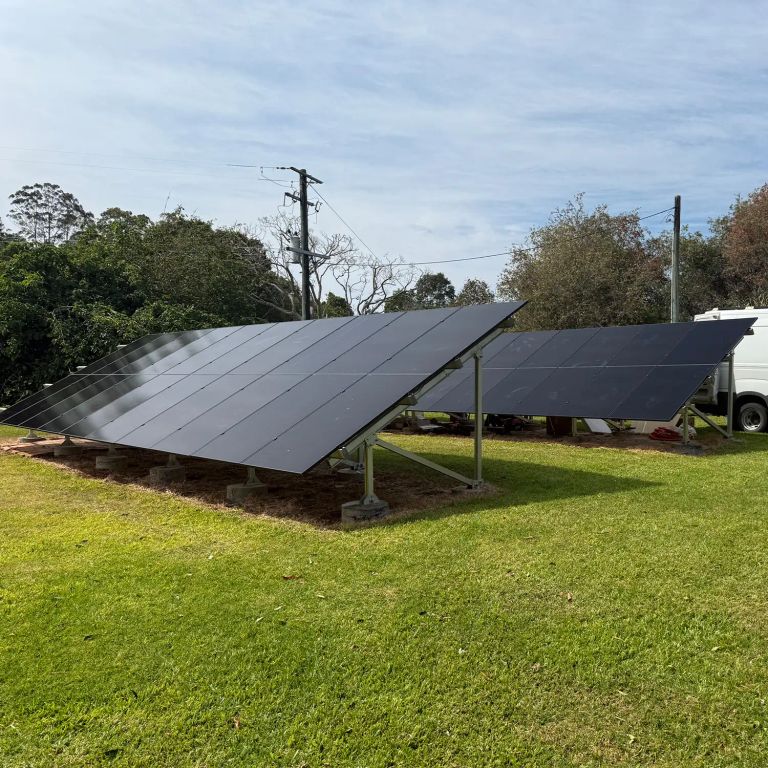
Inland sites have one real advantage here. Tablelands winters are cold but frequently clear, so the recharge windows are good if the array can use them. Ground mounts help twice over: they free you from the shed roof’s orientation, and they let us set a steeper tilt that faces the low winter sun properly. Dust and pollen soiling costs quiet percentages on rural sites, so panels you can reach with a hose are a feature, not a compromise.
Why usable capacity depends on chemistry
Every battery we install is lithium iron phosphate, LFP for short. For off grid work the chemistry earns its place: stable in heat, happy to cycle daily for years, and efficient, with the platforms we use rated around 95 percent round trip efficiency where the manufacturer publishes a figure.
The number to interrogate on any quote is usable capacity, not nominal. Depth of discharge sets how much of the nominal figure you can draw in normal service: the Fox ESS CQ6 works to 90 percent, while the Sigenergy SigenStor and other Fox ESS ranges are rated for 100 percent depth of discharge, and Sungrow states up to 100 percent usable energy on its residential range. A quote written in nominal kilowatt hours can overstate what actually reaches your appliances.
Cold matters too, and it is the tablelands question. LFP batteries discharge happily below freezing but charging is restricted in the cold: the Fox ESS ranges charge from 0 to 55 degrees, with discharge to minus 10, or minus 25 with the optional warm up function, while the SigenStor operates from minus 20 to 55 degrees. In practice we solve this with placement first, a garage or insulated shed rather than an exposed wall, and hardware selection second. Old style lead acid banks, for comparison, punished you with shallow cycling limits, charging fuss and sheer weight; modern LFP is simply a better tool for daily off grid cycling.
Generator integration: backup, not a crutch
Nearly every full time off grid home we design keeps a generator, and that is good engineering rather than an admission of defeat. Its job is narrow: cover the rare stretch of weather beyond your autonomy target, carry unusual loads like a welder running all day, and let you service the system without going dark.
Good integration is what separates a backup from a crutch. The generator connects through the system controller, on the platforms we install by a two wire auto start signal, so it starts itself when the battery reaches a set state of charge, runs under proper load charging the bank efficiently, and shuts down when the job is done. No frosty 5am walk to a pull cord.
Size it to the battery charger’s appetite plus the essential loads, not to the whole house; an oversized generator loafing at low load glazes its bores, wastes fuel and still charges no faster than the system can accept. And keep the honest test in mind: in a well sized system the generator logs tens of hours a year. If a design needs the generator every winter evening, the array or the bank is too small, and fuel drums become a permanent line in the household budget.
The example home, sized end to end
- Daily load. 10 kWh a day, with pumps and workshop counted and the heavy loads shifted into daylight.
- Autonomy. Two days, so about 20 kWh of usable storage: a four module Fox ESS CQ6 stack at 23.96 kWh nominal, about 21.6 kWh usable, fits with margin.
- Array. Sized on the worst winter month with headroom to refill the bank after cloudy runs, ground mounted at a winter tilt where the site allows.
- Generator. Auto start diesel held in reserve, sized to charge the bank properly, expected to run rarely.
That is the whole method. What changes from property to property is the inputs: your loads, your weather, your sun access and how critical your power is. That is a conversation, then a site visit, then a fixed quote with the assumptions in writing. Start on the off grid systems page, or go straight to requesting a design.
Get your loads turned into a design
Send us your load list, or let us build it with you on site. You get a complete off grid design and a fixed quote from the crew that installs it.
Get your free quote
Tell us what you are after and we will come back to you within one business day with real numbers for your property. Prefer to talk? Call 0420 141 078.